
Put Disaster Aside to Simmer
A lesson for apprentices (and me).

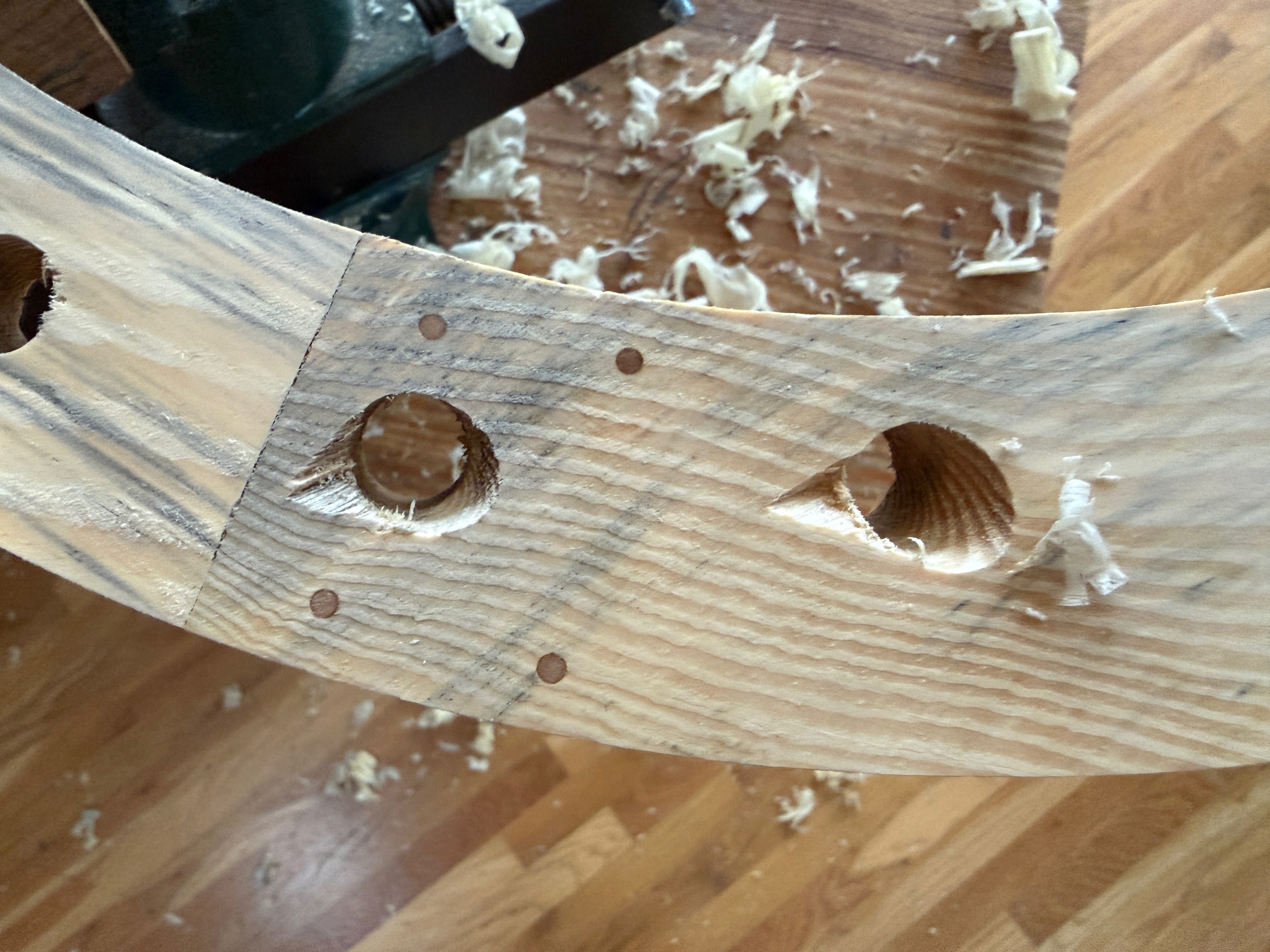
When I built a chair’s armbow using naturally curved wood in April, the whole project went to crap right after I carefully assembled the arm (which took more than a day to cut the mitered half-laps).
When I drilled the assembled armbow to receive the sticks, the surface of the arm turned craterous (see above). Giant chunks of wood popped out around the mortises because the grain in the arm was so confused.
After I finished drilling, I looked at the arm and realized I couldn’t simply plane the blow-out away. I could perhaps fill the craters with epoxy or patch them with a Dutchman, but that might look like crap in the end.
Defeated, I gathered up the chair’s components and put them in our Cellar of Misfit Parts, which is where all my disasters go to wallow. Every time I went into the cellar I’d check up on the arm. Was it as bad as I remembered? Yes. It was worse, actually. Could I fix it? No. I don’t think so.
After about six weeks, I brought the arm back up to my bench and decided to stare at it for a while. Then, I decided to handplane it down to see how much of the chunky blowout I could remove.
Turns out, my brain had been doing some deep thinking about the lame arm. And it had failed to mention it to me.
As I planed the arm, I realized that the deepest craters – the ones I’d have to patch – were all around the mortises for the chair’s long sticks. The holes for the short sticks were clean and easily planed up.


Bah! It hit like a lightning bolt: Glue a thin “shoe” over the holes for the long sticks and redrill those mortises. A thin shoe is a traditional design feature of these vernacular stick chairs. And I wonder if it had ever been used to hide errors in the past (absolutely probably hell yes).
Better yet, I decided to make the shoe slightly thicker than desired. That way I could redrill it and have enough extra thickness so I could plane away any craters that might occur during redrilling.
So that’s what I did. I didn’t use the same species of wood for the shoe because the chair is going to be pigmented with dirt, soot and oil. So I used red elm, which is tenacious. I glued a 1/2"-thick shoe on the arm, redrilled the mortises and planed the shoe down to 1/4" thick. That keeps the arm looking spare, which is the effect I wanted.
I was relieved that I didn’t obey my first urge, which was to cut the arm up for scrap.
Sometimes purgatory is a good place to hang out for a while.
This post reminds me of another rule for apprentices. Sweep the floor. Because sometimes a piece that breaks off or splinters can be found and glued back in. But only if your workspace is tidy.
Glad you found a solution to your problems. You have come so far so quickly.